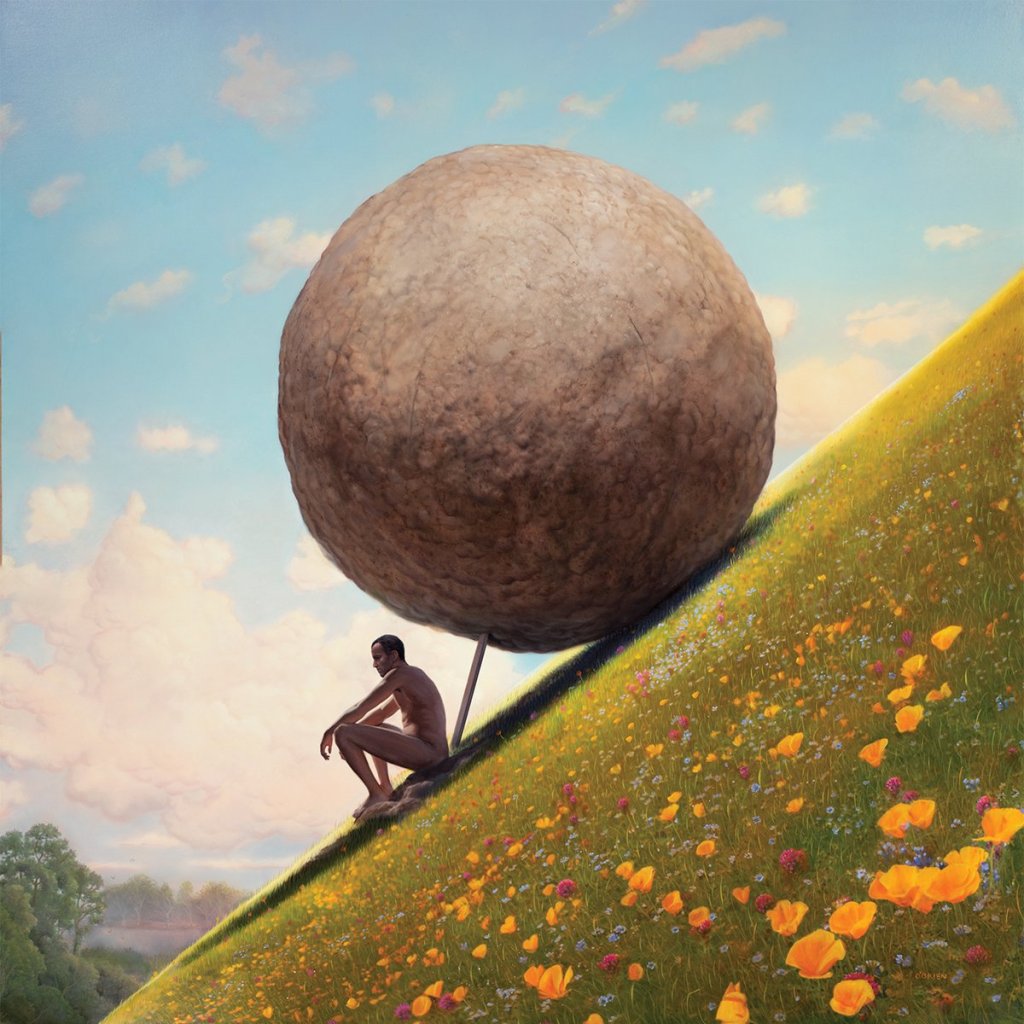
When Sisyphus first laid his fingers on the rough-hewn texture of his burden, did he know he was in hell? The awareness of hell, the context of our being, is of the utmost importance for understanding how to operate, how to feel about the wall we throw ourselves into. From the first day of our lives to the very last, we are told how to be & the path to take to succeed in this world.
The economic & academic tracks had been laid out for those born at the turn of the millennium, a supposedly direct path that would lead us to so many wonderful things: financial stability, peace of mind, inclusion, safety, societal acceptance, & the American Dream. The American Dream is a helluva boulder to push up a hill, the expectations of thousands of years of immigrants, combined with one’s own wishes, desires, & needs. The energy needed to push that boulder is immense, yet people continue to force it, taking step by step up that mountain. Life often comes by & takes our legs out from behind us with randomly disastrous events. We watch our friends, comrades, lovers, & family fall from the mountain, their boulder crushing them unceremoniously at the bottom under the weight of their own dreams.
We start where we all start, in the softness of childhood, in the kindness of our parents’ arms, where the world is set right. Where the rules of lively engagement are laid out for us in a space where we can test the boundaries, throw pebbles toward the base of the mountain. This is where your parents push your boulder up those first few steps, if you’re lucky. If your parents can afford a head start to flatten the mountain for you before you start, it kicks the real challenge down the road for you. Delaying the inevitable, the work will come, whether now, later, & its form will always change accordingly. The boulder is a patient creation, knowing that you can only resist it for so long. All childhoods are talked of so fiercely & fondly because our hands are unburdened by the callouses of pushing, our hearts unburdened by the heartbreak of being alive, our minds free of the suffering that is inherent with being on the mountain. The boulder waits for our strength to grow, for our legs to steady under our own weight before buckling under its inherent adiposity. The boulder needs us to be able & willing to push it up the mountain.
The end of high school is when people usually begin to feel the texture of their boulder, understand what it will take for a lifetime of pushing. They sympathize that life takes work & that work is unceasing & unrelenting; regardless of who you are or your station in life, you have a boulder to push. The textures of the stone change from person to person; some are coated in oil to make getting a purchase very difficult. Some of these boulders are perfectly smooth, but their owners see them as rigid, sharp, & prickly, & are leery of pushing them. Certain others can kick this can down the road, have the route flattened for them by their parents, or make the grade of their mountain much steeper. This stage of life spares no one. The harsh realization that life will require a lifetime of work. This isn’t what was promised to us as kids. The path was meant to be straightforward, no boulders mentioned, deviations are the pits in the ground, the backtracking, the falling, were all glossed over in the introduction. We were told about them, but thought they would be more obvious concerns, like sand traps, rope tricks, & fallen rakes on which to step. Why did society not warn us more that these rocks were so heavy? Because they had to carry them, too?
The first years of work or college are where the boulder starts to chafe, to chap, to callous a once smooth, unworked hand. The first years of effort feel like a breeze, a welcome change from walking around unburdened for so long. The weight feels good under a young body, feet are confidently gaining purchase on the mountain, progress seemingly being made forward. This is where the first people begin to fall off the sheer mountain face, only a few, though, just enough for everyone to know how scary it is to fall, watching those fallen people start back at the beginning, with so much space to climb upwards. The hands & legs will get tired from the constant effort. You can pause & rub your hands, stretch your legs, but it’ll seem like your friends have launched ahead of you again, & when you start to push, the boulder is seemingly heavier than it was before. It’s easy to resolve not taking any more breaks; the actuality of the thing is much harder. This is where the weight begins to become crushing, at the end of youth, all spent pushing along a route they set out for us, that got us to the base of the mountain. To start urging on again, for our whole lives.
So I ask again as I lay my hands down on the rough-hewn texture of my own boulder, do I know that I’m in hell? Or do I just occupy myself with climbing the mountain, with rolling the boulder? Does it change anything to know? Does that make living better or worse? Does rolling boulders, living life, create a collective suffering that we can commiserate over & try to improve for each other?
Can one imagine Sisyphus happy? Can I imagine myself happy? Peaceful, perhaps, if luck be on my side.
Hell wants to distract you with the embers, with the people ahead of you making the path harder, pointing fingers & blaming the people who are starting to push their boulders up the hill. The texture of my boulder is rough, it is smooth, & filled with the words & eyes of a thousand different people who all tell me various things. Antithetical ways to be, to see, to exist, to understand, to evolve, to cope, to suffer. Welcome to my Sisyphean Experiment. It will take my whole life, & I can only be so overjoyed that someone has decided to watch me push my boulder.
 The Writing Menagerie
Leave a comment